Why the HippieBus Weekender Turns Heads
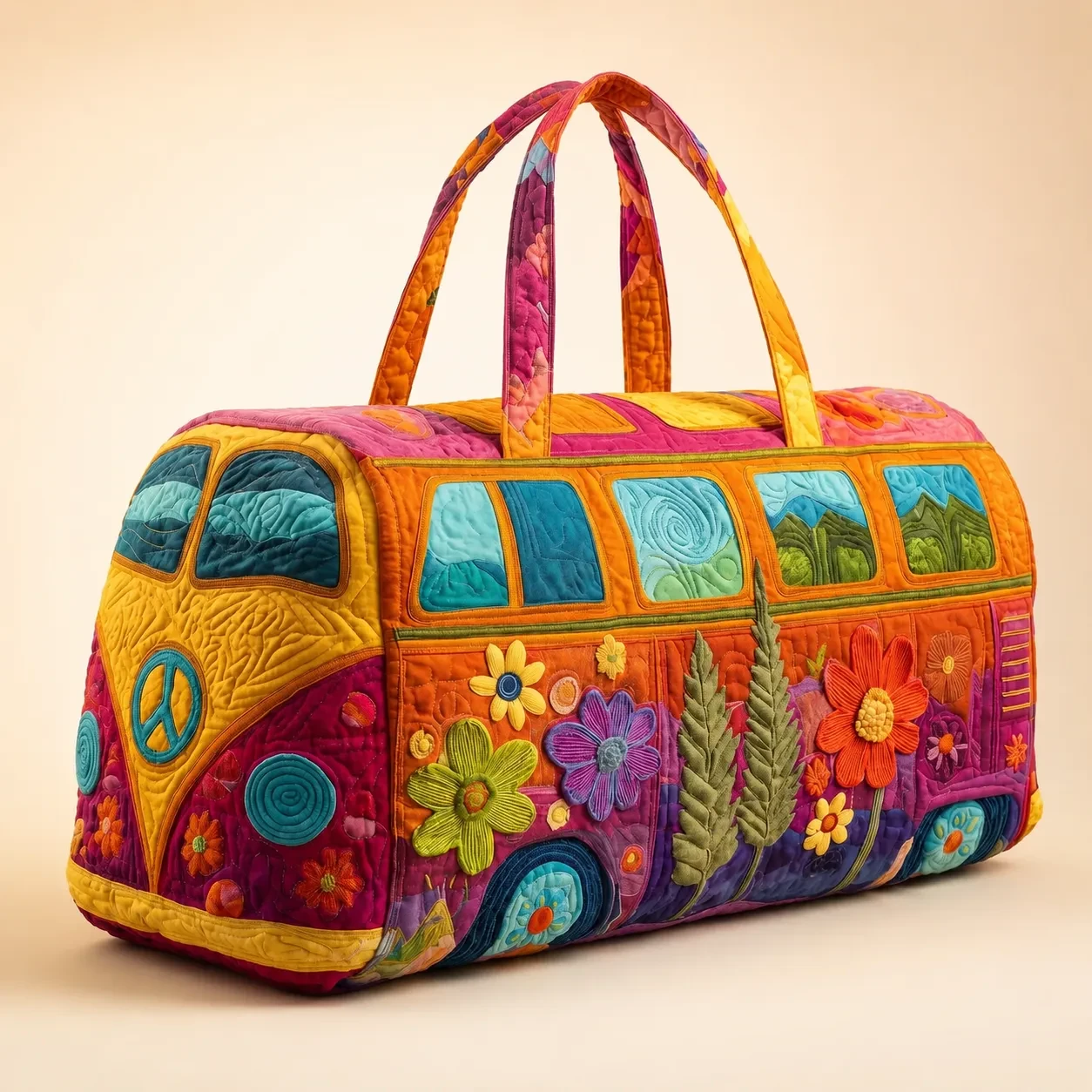
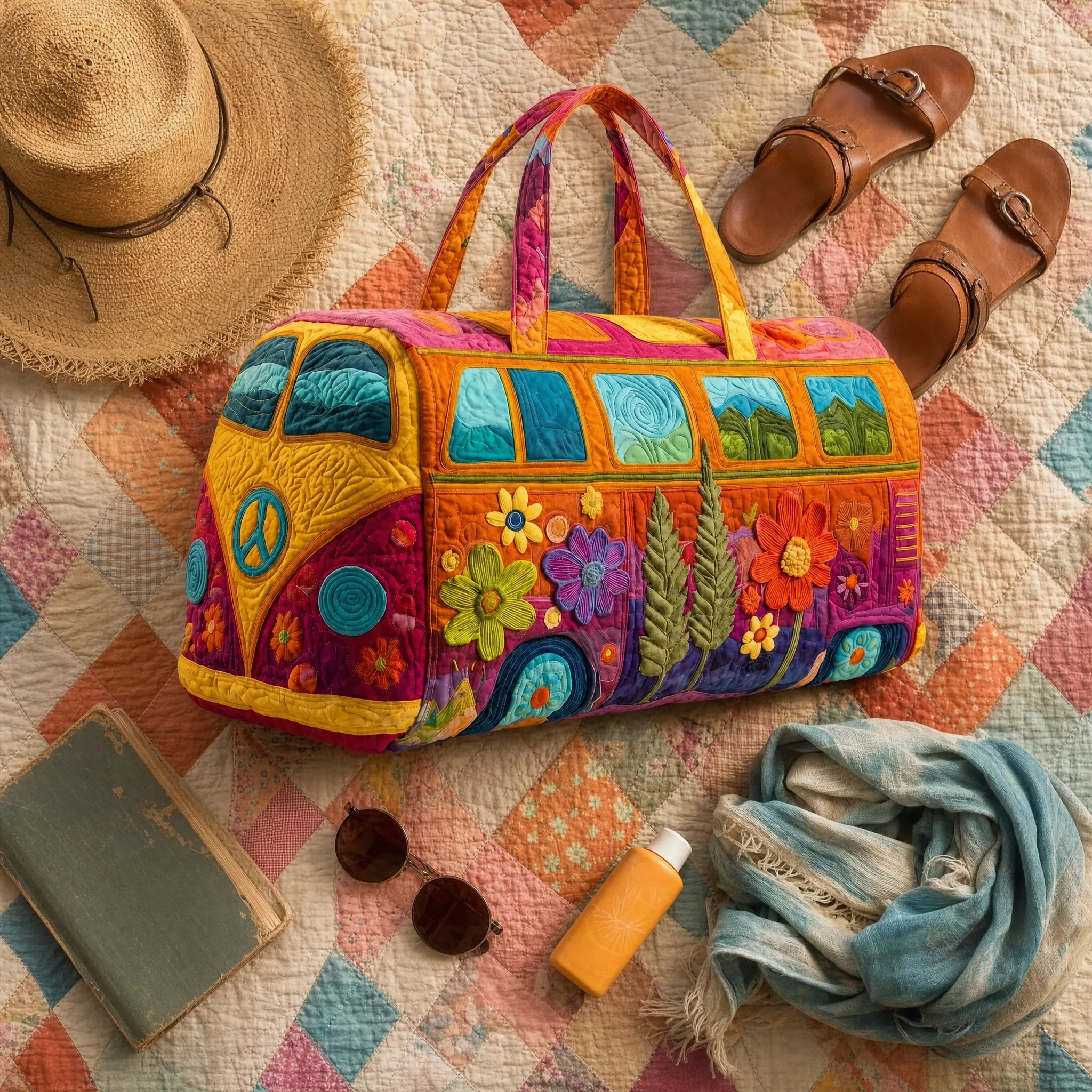
Next to a plain black duffel on the luggage carousel, the HippieBus Weekender is easy to spot from across a room and hard to forget.
Early appliqué was used to lengthen the life of clothing and moved into artful techniques seen in blankets and quilts from many cultures around the world, and on the HippieBus Weekender the layers throw small shadows in bright light and the colors look rich and deep.
Each HippieBus Weekender is finished by hand, from the applique and quilting to the seam binding, so no flower sits in exactly the same spot twice. Those small differences are the proof of the hand.
Appliqué is ornamental needlework in which bits of fabric in all sorts of shapes are sewn down onto a bigger piece until they make a picture. The suns, flowers and rainbows on the HippieBus Weekender are made exactly that way, by hand, so the design rises off the bag.
A Cedar Box, a Painted Bus and a 1986 Road Trip
Painters Ernest Blumenschein and Bert Phillips set up the first artist colony in Taos in 1898, and six artists went on to form the Taos Society of Artists in 1915. The town has more than 80 art galleries today and is known as a counterculture mecca and beacon for artists, which is the kind of place a HippieBus Weekender comes from.
Taos was incorporated in 1934, although people have lived in the neighboring Taos Pueblo for roughly a thousand years, and the town’s name comes from the native Taos language, meaning place of red willows. Every HippieBus Weekender still comes from one adobe workshop there.
In the summer of 1973, Rosie Delgado was 21. She and two friends drove a hand-painted VW bus from Taos down the Baja coast, sleeping on beaches and stopping at every market they passed. The bus was sold on the way home, but a cedar box full of market fabrics and patches made it back.
In 1986 a close friend was about to drive across the country and could not find a travel bag she liked. Rosie opened the cedar box, sat down at her mother's industrial Singer and quilted her a padded weekender with a VW bus across the front.
Strangers stopped her friend in three different diners to ask where the bag came from, and a phone call from Tulsa asked Rosie to make more. A gift shop in Santa Fe took six, then a boutique in Boulder, and in time orders came in from all fifty states.
More than 14,000 HippieBus Weekender bags have left that one adobe workshop since. Rosie is now retiring, and the final batch of about 850 hand-numbered bags is the last run there will ever be.
The Feel of Real Hand Quilting
Quilting joins three or more layers of fabric, sewn by hand with needle and thread or by machine. Rows of stitches go through every layer and raise a soft, padded surface, and that padded surface is the body of the HippieBus Weekender.
The layers of a quilt are usually known as the top, the batting in the middle and the backing. In this bag the batting is cotton, built up by stitches rather than glued-in foam, so it softens with use instead of crumbling or sagging.
Hand quilting is the process of using a needle and thread to sew a running stitch by hand across the entire area to be quilted, and this binds the layers together.
A quilter can drive the needle through from the right side and push it back up from the wrong side, which is called a stab stitch, or use a rocking stitch with a thimble on top, and hand quilting is still practiced by the Amish and Mennonites in the United States and Canada. That same running stitch holds every HippieBus Weekender together.
In American Colonial times, quilts were mostly whole-cloth quilts, a single piece of fabric layered with batting and backing held together with fine needlework, and patchwork quilting in America dates to the 1770s. The HippieBus Weekender carries that long American quilting tradition onto the road.
About 14 hours of handwork go into every HippieBus Weekender, which is the honest reason only a few hundred are left in this last batch. Set one down empty and it keeps its shape, as if it were already packed.
Inside the HippieBus Weekender: Room for a Real Weekend
Main compartment
Two to three days of clothes, shoes and a wash bag.
Interior pocket
Charger, glasses, keys or jewelry.
Padded quilted handles
Soft over the shoulder or in the hand.
Most sources say the name duffel comes from Duffel, a town in Flanders, Belgium, where the thick duffel cloth used to make the bag originated in the 17th century. A duffel bag is often used in place of a suitcase and is compressible when empty, so the HippieBus Weekender tucks onto a shelf or under a bed.
Packing the HippieBus Weekender the Easy Way
Shoes go along one side of the HippieBus Weekender in a small bag with socks tucked inside. The toiletry kit sits near the top, so it comes out first at the hotel or the guest room.
Roll soft clothes instead of folding them and lay them in the bottom of the HippieBus Weekender first. Rolled shirts and leggings fill the corners and leave the top free for a sweater or jacket.
There is normally storage space for hand luggage either under the seat or in the overhead lockers, and a soft bag of this size slides into either one, with small things kept handy in the interior pocket.
Where the HippieBus Weekender Goes
A duffel bag is often used in place of a suitcase, and the HippieBus Weekender brings that handy shape to every kind of short trip.
Weekend getaways
Two nights at the coast or a cabin.
Road trips
Slides into a packed trunk.
Overnight stays
A sleepover or a hotel night.
Everyday carry
The gym, the market, the lake.
A road trip can be planned or done on a whim. In the mid-to-late 20th century road trips became a topic of recreation as opposed to economic necessity, and they have long been tied to cultural movements such as the bohemian hippies, music festivals and the counterculture of the 1960s, which is the same spirit the HippieBus Weekender was born from.
The modern American road trip began to take shape in the late 1930s and 1940s, ushering in an era of a nation on the move, and a soft bag that fits the back seat has been part of it ever since. The HippieBus Weekender keeps that tradition going.
A road trip is a long-distance journey by car, typically for recreation, or to visit relatives and friends, and the HippieBus Weekender is made for exactly that kind of trip, from a weekend at the lake to a long visit with family.
A Gift With a Number Written on It
The three-bag and four-bag bundles bring the price per bag down a long way and ship free, so one HippieBus Weekender can stay home and the others can go to people you love.
Slow fashion asks people to buy fewer things of better quality and keep them longer, and studies of the movement note that people hold on to items they feel emotionally or culturally connected to for many seasons. A numbered, handmade HippieBus Weekender tends to become one of those keepers for a birthday, a retirement or a daughter heading to college.
Every HippieBus Weekender has a cloth tag with its number written by hand, which ties the bag back to the workshop and the person who finished it, and that is rare for a bag under $100.
Made to Last, Made to Mend
Appliqué itself began as a way to strengthen worn areas of items or to patch holes, so a colorful patch or a few bright stitches only add to the character of a HippieBus Weekender meant to be carried for years and maybe handed down one day.
Visible mending is a way of repairing an item so the repair shows, with less importance on speed and more on the decorative side. The dual goals are to adorn the item and to draw attention to the fact that it has been mended, and the hand-sewn seams of the HippieBus Weekender can be mended by hand in just that way.
Slow fashion is part of the slow movement, which favors a way of making clothing and goods that is respectful to people and the environment. In contrast to fast fashion, slow fashion involves local artisans, and the emphasis is on quality pieces that are more enduring, which describes the HippieBus Weekender well.
Three Signs of a Genuine HippieBus Weekender
A genuine HippieBus Weekender always has a cloth tag in the interior pocket with its own number written by hand on it, and that number is never repeated on another bag from the Taos workshop.
A lookalike can copy a bus shape but not the numbered tag or the handwork, so the official store is the only place to get the real HippieBus Weekender.
Hand quilting stitches have small changes in length and angle from one to the next, which a machine line does not have, and on a HippieBus Weekender those little changes run all the way around the bag.
In sewing, an appliqué is made by attaching smaller pieces of fabric to a larger piece of contrasting colour or texture, with the edges folded under and then stitched down. Run a hand over the bus on the HippieBus Weekender and each window and flower can be felt as its own piece.
HippieBus Weekender Compared With Ordinary Weekend Bags
| HippieBus Weekender | Printed Canvas Duffel | Nylon Gym Duffel |
|---|
| Design | Layered fabric applique | Ink printed on top | Plain or logo |
| Padding | Hand-quilted cotton batting | Thin or none | Foam or none |
| Made | By hand in Taos, NM | Factory line | Factory line |
In the US the Volkswagen Type 2 is known as a VW bus, minibus, hippie-mobile, hippie bus or hippie van, and the early versions produced before 1967 used a split front windshield, giving rise to the nickname Splitty. The next version, sold in the US from 1968 to 1979, had a large curved windshield and is commonly called a bay-window, and that friendly rounded face is the one sewn on the HippieBus Weekender.
HippieBus Weekender Final-Batch Prices
Every bag in this final batch is 50% off or more, ships within 48 hours and has its hand-numbered tag sewn in.
Single1 Bag
$139.90 $69.95/ea
Total $69.95 + shipping
Gift Pair2 Bags
$139.90 $62.95/ea
Total $125.90 + shipping
Free Shipping3 Bags
$139.90 $51.76/ea
Total $155.28 · Free shipping
Best Value4 Bags
$139.90 $41.97/ea
Total $167.88 · Free shipping
When the last hand-numbered HippieBus Weekender in this batch is gone, the design is retired for good.
30 Days to Fall for Your HippieBus Weekender
Every HippieBus Weekender comes with a 30-day money-back guarantee, so it can go on real trips and still be sent back within 30 days of delivery for a refund.
Orders ship within 48 hours with tracking by email. Customer care is at help@spark-tek.co or +1 (424) 250-4182.
HippieBus Weekender Customer Reviews

★★★★★
The seams tell the story
I put mine next to my daughter's designer duffel and made her look at the seams with her reading glasses. Hers looked like a printer did it. Mine looks like a person did it. That was the whole argument, and I won.
Pam W. · Verified Buyer

★★★★★
Keeps its shape on the shelf
It sits on my closet shelf between trips looking like a little piece of furniture. My old duffel used to slump behind the door like a deflated balloon. This one stands up on its own, even empty.
Michelle T. · Verified Buyer

★★★★★
Opens completely flat
The zipper wraps around the top like a suitcase, so the whole bag opens flat. The padded handles do more work than a number on a scale would suggest. My shoulder complains about my purse before it complains about this.
Dana Rowe · Verified Buyer

★★★★★
Softer every trip
Softer every trip, never saggy. The quilting gives it a cushioned weight that foam bags just fake. Eight months of weekend trips in, it has broken in like a favorite jacket, and my family keeps asking to borrow it.
Carol M. · Verified Buyer

★★★★★
The airport conversation starter
Three people stopped me at the Albuquerque airport. Three. One woman took a photo of the bus panel while I held the bag up like a fishing trophy. I have owned cars that got less attention than this bag.
Judy K. · Verified Buyer